· 2 min read
The Unlit Corner: Chiaroscuro and the Truth of Shadows
grimoire

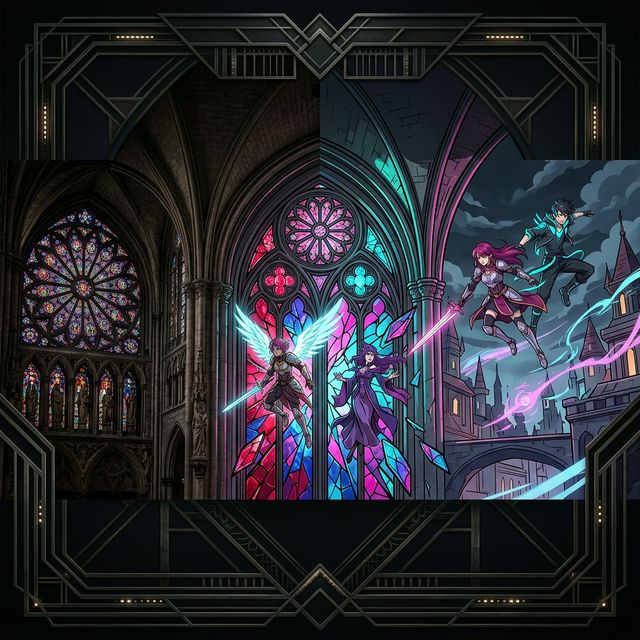
How Japanese animation aesthetics and European gothic art share a visual language, and what that means for AI style transfer.
StyleFusion’s gallery has a recurring pattern: gothic anime line art consistently produces some of the most striking outputs. That’s not a coincidence. There’s a deep structural connection between Japanese animation aesthetics and European gothic art that makes them unusually compatible for style transfer.
Gothic art (12th through 16th century European, not the modern subculture) and anime share geometric principles that shouldn’t overlap but do.
Elongated proportions. Gothic architecture stretched everything vertical: pointed arches, ribbed vaults, spires reaching upward. Anime characters are drawn with elongated limbs and exaggerated vertical proportions. Put them in the same frame and the proportions rhyme.
Line weight as emotion. Gothic manuscript illustration used line weight variation to indicate importance and emotional register. Thick outlines for primary figures, fine lines for detail, dramatic contrast between the two. Anime does exactly the same thing. Compare a page from the Très Riches Heures du Duc de Berry with a panel from Berserk and the line weight logic is nearly identical.
Flat color fields with extreme detail. Gothic stained glass windows are flat color fills bounded by heavy dark outlines, with incredible detail within each field. Cel-shaded anime is the same principle: flat color fills, strong outlines, detail concentrated in specific areas (hair, eyes, clothing folds) while other areas stay clean.
When StyleFusion generates a “goth anime” image, the AI model doesn’t know about art history. But the training data contains both traditions, and because they share structural principles, the latent space between them is navigable.
The visual atoms that define “gothic” (high contrast, vertical emphasis, ornate detail, dark palette) and the atoms that define “anime” (clean linework, expressive eyes, stylized proportions, flat color) don’t conflict at the structural level. They reinforce.
Compare this with “anime meets Impressionism.” Those styles have contradictory texture atoms: anime wants clean edges, Impressionism wants dissolved edges. The AI model has to pick a winner, and the results often look muddy.
There’s a historical connection too. When Japanese artists first encountered European art through Dutch traders in the Edo period, gothic and Renaissance prints were among the earliest Western images to reach Japan. The influence was subtle but real: the compositional formality of ukiyo-e woodblock prints shares principles with gothic altarpiece composition.
Modern anime inherited those compositional conventions. The frontal portrait, the formal pose, the decorative frame, all of these are gothic structures that traveled through ukiyo-e into manga and eventually anime.
When you work with StyleFusion, understanding which styles are structurally compatible produces better results than forcing incompatible aesthetics together. The Grimoire’s knowledge graph encodes these compatibility relationships: style atoms that share structural principles have strong positive connections; conflicting styles have negative weights.
Gothic and anime are a strong positive connection. So are Art Nouveau and psychedelia (both use organic flowing lines). And Bauhaus and pixel art (both use geometric grid constraints).
The interesting creative territory is where you combine styles that have partial overlap: enough compatibility to produce coherent results, enough tension to produce something unexpected. That’s where the Grimoire’s conflict resolution becomes a creative tool rather than just an error handler.