
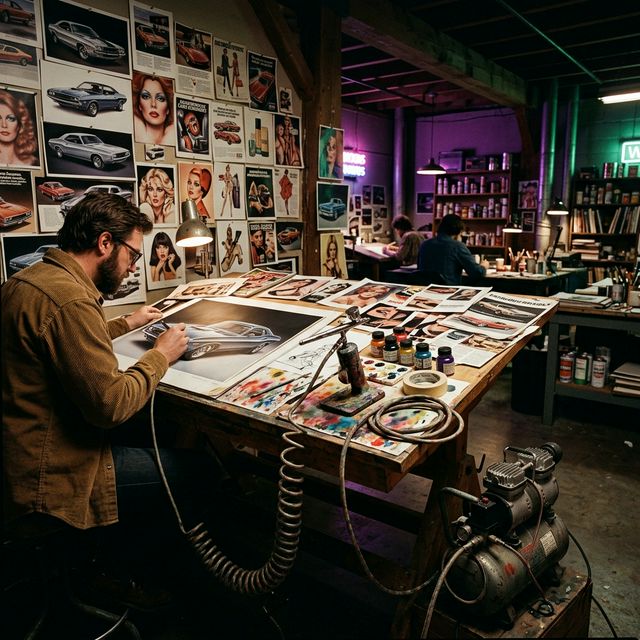
1973: When Airbrush Was AI
How the airbrush revolution in 1970s commercial illustration mirrors today's AI image generation debate, and what happened after.
Open any magazine from 1973, a Playboy, a National Geographic, a Popular Mechanics, and you’ll see the airbrush everywhere. Photorealistic illustrations of cars, faces, landscapes, all produced with a tool that most traditional illustrators considered cheating.
Sound familiar?
The Airbrush Controversy
The airbrush existed since the 1890s, but it exploded in commercial art during the early 1970s. Artists like Hajime Sorayama, Peter Sato, and the Hipgnosis studio (responsible for Pink Floyd album covers) pushed the technique into territories that blurred the line between illustration and photography.
The traditional illustration community pushed back. The arguments were remarkably similar to today’s AI art discourse:
“It’s not real art. The tool does the work.” Airbrush critics argued that the smooth gradients and photorealistic effects were mechanical, not artistic. The tool’s capability, not the artist’s skill, produced the result.
“It will replace real illustrators.” Commercial clients started requesting airbrush work specifically, because it looked modern and photographic. Pencil and brush illustrators saw their commissions shrink.
“Anyone can do it.” The airbrush lowered the barrier to certain effects (smooth gradients, soft transitions) that previously required years of brushwork mastery. Studios could train junior artists to produce acceptable airbrush work faster than training traditional painters.
What Actually Happened
The airbrush didn’t kill illustration. It created a new branch. Hyper-realist airbrush work became its own discipline with its own masters. Traditional illustration continued, adapted, and in some cases experienced a revival specifically because the airbrush aesthetic became overexposed.
By the mid-1980s, the airbrush itself was being displaced by digital tools. Photoshop’s gradient and masking tools could replicate most airbrush effects faster and with undo capability. The airbrush artists who survived were the ones whose work had creative vision beyond the tool’s technical capability.
The pattern: new tool arrives, panic, adoption, oversaturation, maturation, and eventually the tool becomes invisible infrastructure. Nobody argues about whether Photoshop is “real art” anymore. It’s just a tool.
The 1973 Magazine Spread
Pull a copy of a 1973 Omni or Penthouse from a used bookstore (or the Internet Archive) and look at the advertising illustrations. You’ll see airbrush work that was considered cutting-edge, maybe even threatening, at the time. Fifty years later it looks warmly nostalgic.
The technical quality is impressive even now. The creative range, though, is narrow. When everyone uses the same new tool, the output converges. Airbrush illustration in 1973 has a sameness to it: the same smooth skin, the same chrome reflections, the same sunset gradients. The tool’s default aesthetic dominates.
AI image generation in 2026 has the same convergence problem. “Midjourney style” is recognizable on sight. So is “Stable Diffusion aesthetic” and “DALL-E look.” The default outputs cluster around each model’s training biases.
Why StyleFusion Exists in This Context
StyleFusion’s entire design philosophy comes from this historical observation. The tool’s default aesthetic is the enemy of distinctive creative work. If you let the AI model’s biases drive the output, you get technically impressive images with no creative identity.
The Grimoire, the visual atoms, the prompt compilation pipeline: all of it exists to push past the model’s defaults toward specific, intentional creative directions. It’s the same challenge airbrush masters faced in the late 1970s when they had to develop personal styles that transcended the tool’s built-in look.
The artists who thrived weren’t the ones who were best at operating the airbrush. They were the ones who had a creative vision that the airbrush served. The tool was a means, not the message.
Same principle applies now.