The Vocabulary Problem
Every creative professional carries an internal vocabulary: “chiaroscuro,” “brutalist,” “wabi-sabi,” “Art Deco geometry.” These terms encode complex bundles of visual information. But they live in individual heads, inconsistently applied, rarely defined with enough precision for a machine to use them reliably.
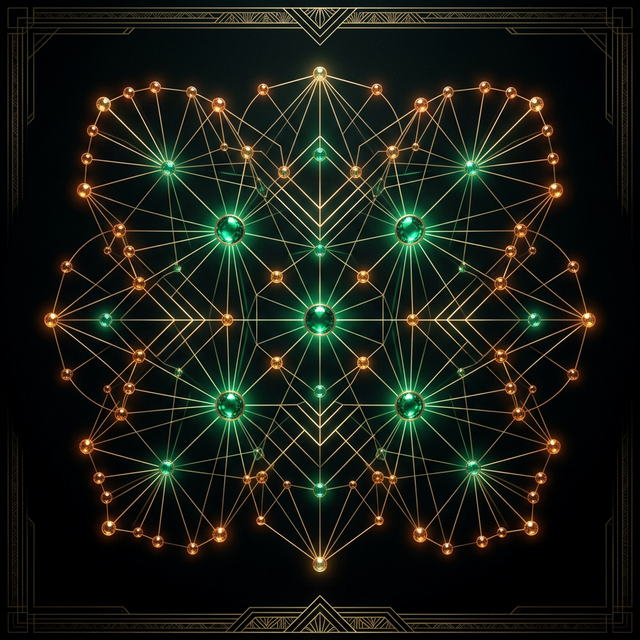
Grimoire is a knowledge graph that makes this vocabulary explicit and queryable. Each aesthetic concept becomes an atom: a node with a name, a definition, visual examples, and measured relationships to other atoms. “Art Deco” is not just a label. It connects to geometric repetition, metallic surfaces, symmetrical composition, specific color palettes, and historical context going back to the 1920s.
Atoms, Arrangements, and Correspondences
The graph has three primary structures. Atoms are the base units: individual aesthetic concepts with definitions and example references. Arrangements are curated compositions of atoms that work together: a specific combination of lighting, color, texture, and composition that produces a coherent visual result. Correspondences are the edges: weighted relationships between atoms that encode how concepts interact.
Not all relationships are equal. “Rembrandt lighting” has a strong correspondence with “dramatic portrait” and a weak one with “flat product photography.” These weights are not guesses; they are derived from analyzing thousands of reference images and their tagged attributes. The graph learns which combinations produce harmonious results and which create visual tension.
Harmonic Scoring
When StyleFusion needs to compile a prompt, it queries Grimoire for harmonic scores. Given a set of selected atoms (say, “cyberpunk,” “neon lighting,” “rain-slicked streets”), the graph returns a compatibility score for each potential addition. Adding “warm golden hour” scores low: it fights the established palette. Adding “chromatic aberration” scores high: it reinforces the visual language.
This is not a recommendation engine suggesting what you should create. It is a consistency checker ensuring that the elements you choose support each other. You can override any score; the system tells you what works together, not what you must do.
Why Structured Vocabulary Beats Raw Prompts
The core insight: raw text prompts treat language as the interface to visual creation. But language is ambiguous, context-dependent, and inconsistent across models. A structured vocabulary with explicit relationships and measured compatibilities gives you repeatable control. You describe what you want in precise terms, and the system translates those terms into whatever format each provider needs. The vocabulary is the stable layer; the prompts are the compiled output.