· 7 min read
How to Fix Slop
cultural-thread

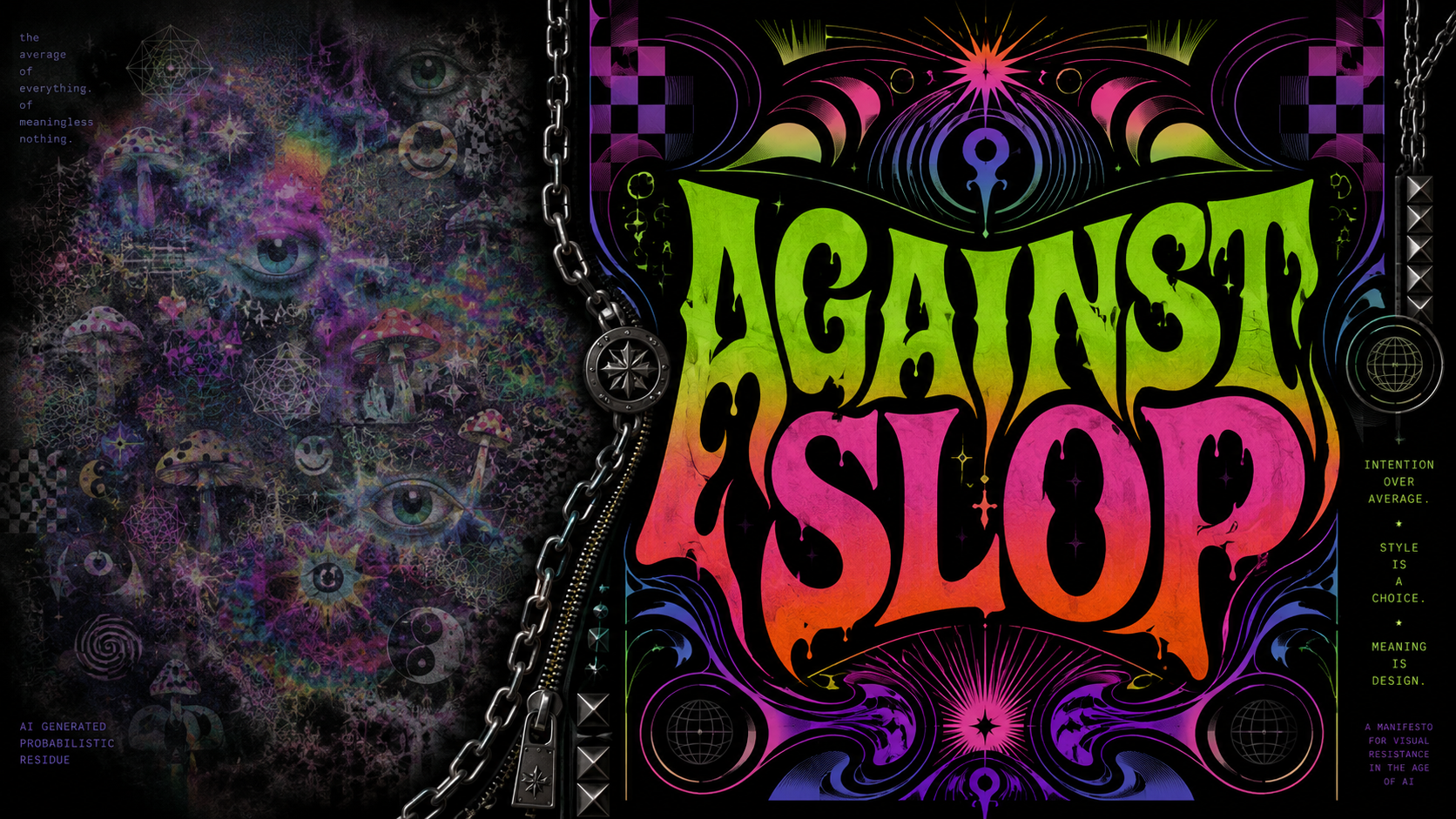
Manifesto #2. The monoculture is dead, every aesthetic is somebody's encoding, and slop is what happens when you let the machine average the residue for you.
Type “psychedelic poster” into an image model and you get mushrooms and eyes. You wanted fractals and geometry, or liquid letterforms, or anything at all that wasn’t mushrooms and eyes. The model isn’t broken. It handed you the statistical average of everything the word “psychedelic” left behind on the internet. That average has a name now: slop.
The 80s had an aesthetic because a system manufactured one. Three networks, MTV, monthly magazines on every rack, the same movies in every mall. The 60s, same story with different machinery. Those systems are gone. What’s left is residue: the films, the magazines, the photographs, the relics they produced. Nobody is building “the 2020s aesthetic” because there is no machine left to build one. Culture fractured into micro-scenes with their own feeds and their own canons, scenes that mostly can’t see each other and often don’t like what they see when they do.
That sounds like a loss. It’s the best raw-material situation an artist has ever had. Every dead monoculture left its archive behind, and the archives have never been easier to reach. The only question is what you do with residue.
Rick Strassman ran the DMT studies that named it the spirit molecule. He’d practiced Zen for twenty years. And his framework broke on his own data: Buddhism filed the visions his volunteers reported under illusion, while the volunteers came back insisting what they saw was as real as this room or more so. Strassman eventually left Buddhism and reached for the Hebrew prophetic tradition instead. Not because Hebrew prophecy is the correct lens for DMT. Because it was his inheritance, his archive, his encoding.
That’s the part everyone misses about psychedelic art. The sacred geometry, the chakras, the serene Buddha floating in fractals: that is one interpreter’s encoding of the experience, repeated until it got mistaken for the experience itself. My archive is movies and music, so my psychedelia comes out as Busby Berkeley kaleidoscopes, concert posters, and goth hardware. Neither version is the true one. There is no true one. The problem is a million people copying a single encoding without ever realizing it’s an encoding.
Pull the actual San Francisco posters, 1966 to 1971, and the icon kit isn’t there. Wes Wilson built his melting letterforms off Alfred Roller’s 1903 Vienna Secession lettering and made them deliberately hard to read, because a poster you have to decipher is a poster you stare at. Victor Moscoso came out of Josef Albers’s color courses at Yale and inverted the training on purpose: complementary colors at equal intensity, jammed together so the page physically vibrates. Mouse and Kelley raided Mucha and old advertising art. The signature of the era was liquid: letters that flow, swell, and melt. Mushrooms appear when mushrooms are the subject. Eyes appear when the design calls for an eye. The press did call it psychedelic at the time, but what was inside the word was Art Nouveau revival plus weaponized color theory.
Then the contents of the word got swapped. Blacklight head-shop posters flattened the style into an icon kit. Decades of aggregator scraping averaged the icon kit. Models trained on the average. The word survived; the visual DNA didn’t. “Psychedelic” in a prompt no longer points at Roller letterforms and vibrating color. It points at the compressed residue of the residue.
There’s a woman on YouTube who styles her hair with 1920s tools and 1920s methods. The actual techniques, the way women did it a hundred years ago. She is not a reenactor. She has tattoos, piercings, and a modern goth look. She went into the archive, learned how the thing was really done, kept what she wanted, fused it with her own lane, and came out with a style that belongs to her. Nobody in 1925 looked like her. Nobody at the mall goth store looks like her either.
That’s the first way: archaeology, then deliberate fusion. Learn the original method. Understand why it worked, not just what it looked like. Take what’s alive in it. Merge it on purpose with something it never met.
The second way is to grab fragments off a moodboard and mash. No research, no method, no reasons. That practice is older than AI. AI just industrialized it.
Slop is not a vibe accusation and it is not an anti-AI position. I make my work with these models every day. Slop is a checklist:
And slop compounds. Millions of people prompt the token, like what they get, and flood Etsy, social media, and image search with it. The next generation of models trains on the flood. The median narrows, the narrower median floods harder, and the loop runs again. Nobody in the chain is wrong on purpose. The system maintains it, and there is no correction step unless somebody builds one.
Psychedelic goth is the case study: a style built by these rules, from named sources, with declared mechanics and recurring motifs. The definition is here: Psychedelic Goth: A Definition. The way I keep a style from sliding into slop is here: How to Fix Slop. The galleries prove it daily: the galleries.
Manifestos are cheap. The work is the argument.